
Surface finish is one of the quietest ways to inflate the price of a machined part, because it rarely looks like a cost decision. It looks like a note. And unlike a tolerance, which at least announces itself with a number most engineers respect, a finish callout gets copied forward for years without anyone asking what it is protecting.
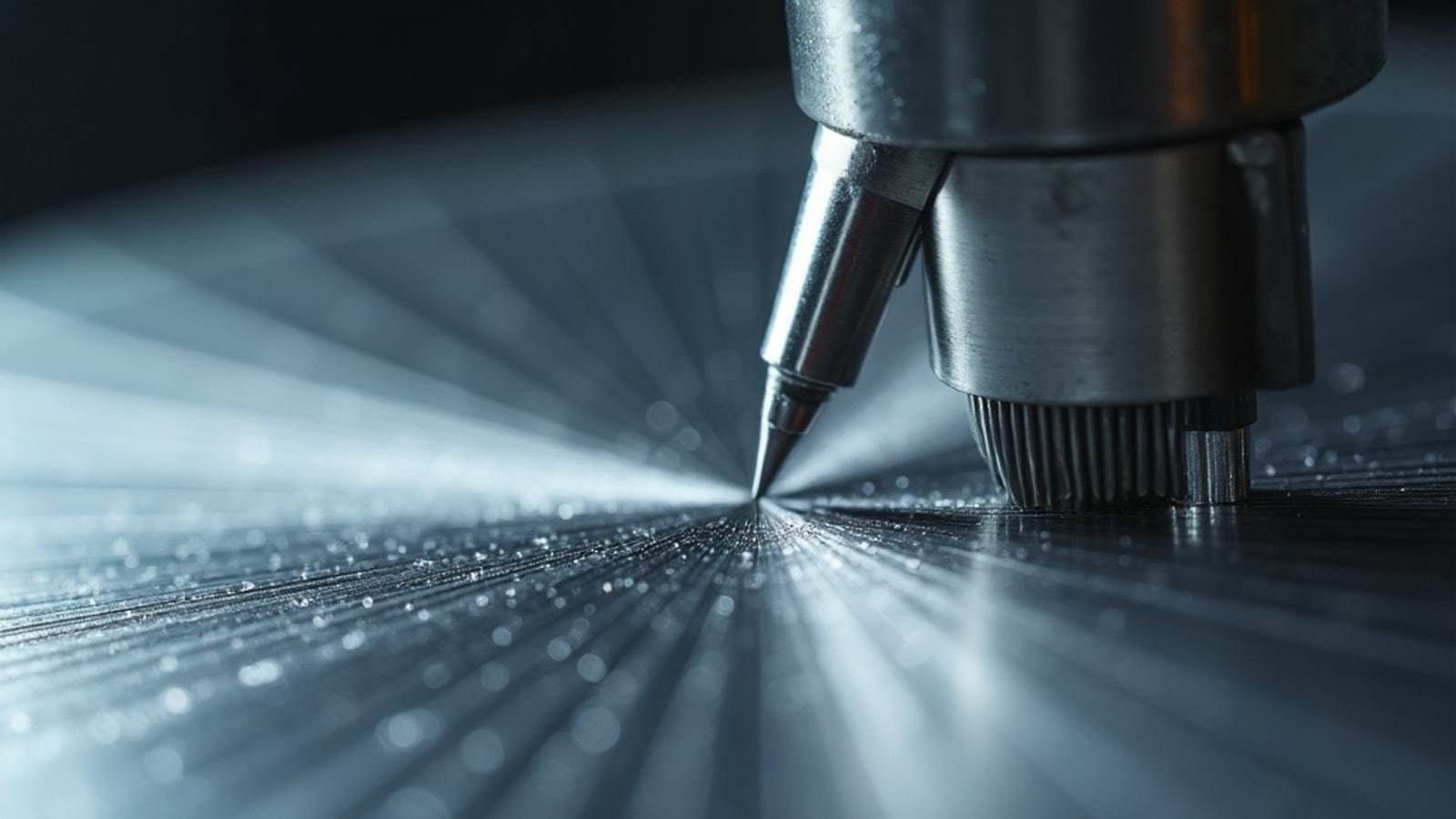
What Ra is measuring
Ra is the most common measure of surface roughness: the average of the microscopic peaks and valleys machining leaves behind, expressed in micrometers. High Ra is a rougher surface, low Ra a smoother one. Standard turning lands around 1.6 to 3.2 micrometers. Fine grinding takes it down to 0.2 or below, close to a mirror.
Stated that way, smoother sounds strictly better. The trouble shows up on the invoice, and the reason is in the process table.
What each process delivers, and what it costs to get there
| Process | Typical Ra (µm) | Relative cost |
|---|---|---|
| Standard milling or turning | 1.6 to 3.2 | Baseline |
| Fine cutting pass | 0.8 to 1.6 | Higher |
| Wire EDM | 0.4 to 0.8 | Higher |
| Grinding | 0.1 to 0.4 | High |
| Polishing or lapping | below 0.1 | Very high |
Read down that middle column and the jumps look modest. Read down the right-hand one and they are not, because each step is buying something different than the last.
Why halving Ra does not double the cost
It usually costs considerably more than double. Each step toward a lower Ra brings slower passes and better tooling, and at some point it stops being a setting and becomes an entire additional operation: a grind, a polish, a lap, each with its own setup, its own handling and its own inspection. A part that would have been finished on the mill now visits a second machine. That is not an increment, it is a new process step, and you pay for the whole thing.
It is the same pattern we described in machining tolerances: precision beyond the function does not show up in the part, it shows up in the price.
The number comes from the job, not from the drawing template
Here is the part worth keeping. The correct Ra is not an aesthetic preference and it is not a house standard. It is a property of what that specific surface has to do. A sealing face, or a bore where a shaft seal rides, genuinely needs a fine finish, because roughness there becomes a leak path or a wear rate. A surface that gets bolted down and never seen again needs nothing beyond the natural finish of the cut. Specifying a mirror on that hidden face is money converted directly into nothing.
The practical rule follows from that. Call out fine finish only on functional surfaces: seals, sliding contact, press fits, and cosmetic faces a customer will actually look at. Leave the rest at whatever the process naturally produces. That way you are buying smooth where smooth does work, and not where nobody will ever touch it.
How to put it on the drawing
Mark Ra with its value on the surfaces that require it, and leave a general note covering everything else. If you are not sure what a given face needs, it is worth asking whoever will machine it. Sometimes a change of process gets you there in one step for less money: wire EDM can deliver 0.4 to 0.8 µm directly on hardened material, where the milling-plus-polishing route would need two operations and a heat treatment in between.
What is Ra in surface finish?
Ra is average surface roughness, measured in micrometers. It describes how smooth or rough a surface came out of machining. A low Ra means a smoother surface, a high Ra a rougher one.
What Ra is a good surface finish?
It depends entirely on function. Standard turning gives 1.6 to 3.2 micrometers, which suits most surfaces. Seals and sliding contact typically want 0.4 to 0.8 or finer. There is no universally good Ra, only the correct one for each surface.
Why does a finer finish cost more?
Because it requires slower passes, better tooling and often an entire extra operation such as grinding or polishing, plus more inspection. The cost rises faster than proportionally, so it is worth specifying only where function justifies it.
How do I specify surface finish on a drawing?
Put the Ra value on the surfaces that need it and cover the rest with a general note. Applying a fine finish to every face by default is one of the most common causes of unnecessary cost on a machined part.